
Most websites were originally designed only for human visitors, not modern search systems, AI platforms, or semantic interpretation.
While users may quickly understand what a company does, search engines and AI systems rely heavily on structured signals to interpret relationships between services, industries, expertise, geographic relevance, and organizational authority.
As search ecosystems continue to evolve, fragmented architecture often leads to weaker discoverability over time. Services become disconnected from supporting content. Geographic relevance becomes inconsistent. Internal relationships weaken. Search systems struggle to confidently understand expertise and authority.
At Incend Media, we help businesses create stronger structural clarity underneath their websites so modern search and AI systems can better interpret who they are, what they do, where they operate, and how their expertise connects together.
Disconnected pages often weaken topical authority and semantic relationships.
Search systems may struggle to understand how services connect together.
Fragmented geographic information often reduces local discoverability.
Weak structure frequently creates confusing machine-readable signals.
Search systems increasingly rely on entity relationships to interpret expertise and relevance.
Disconnected page relationships often reduce broader contextual understanding.
Modern websites must support fast, reliable performance across phones, tablets, laptops, and desktop devices.
Website performance increasingly influences search visibility and discoverability.
Modern AI systems depend on technically accessible websites capable of reliable content retrieval.
Reliable infrastructure helps reduce operational instability and technical interruptions.
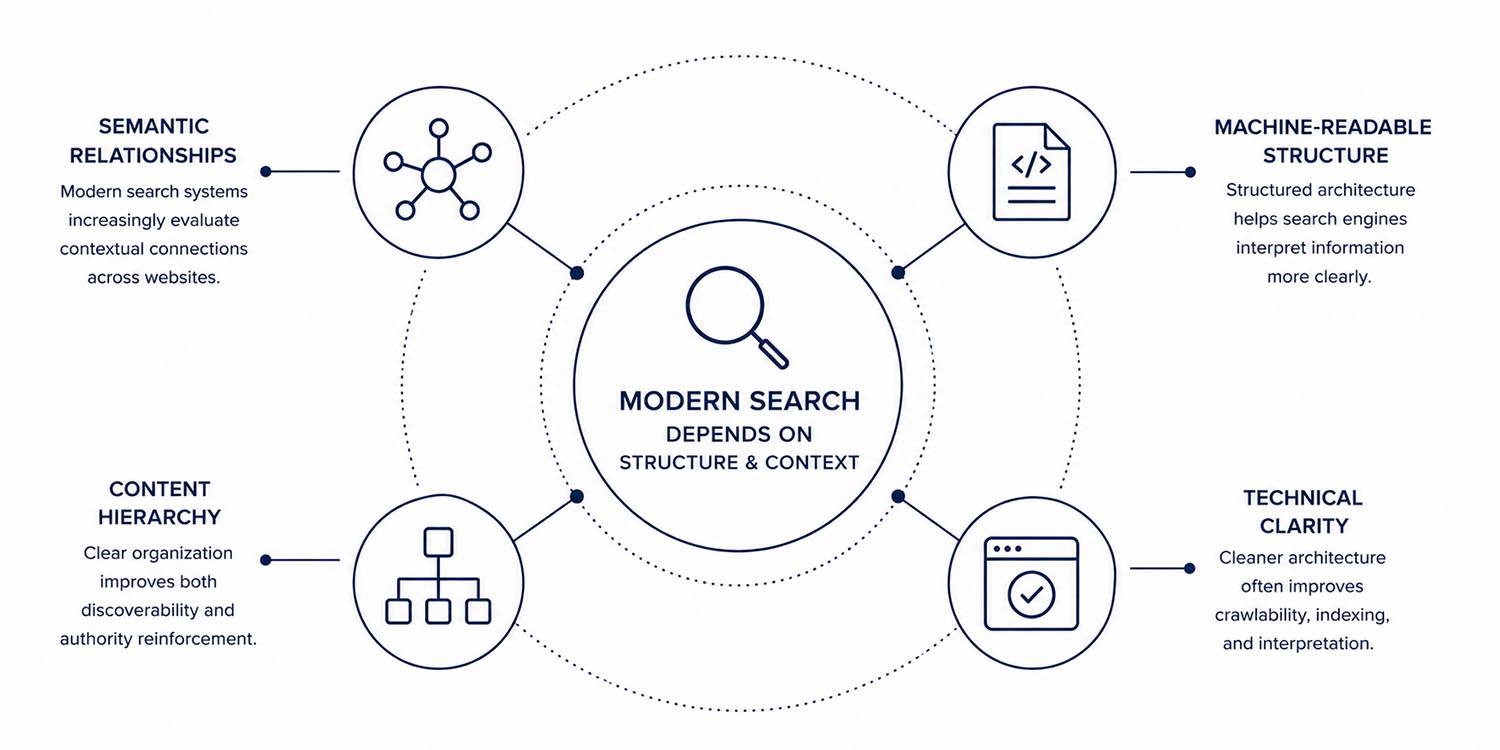
Modern search systems increasingly evaluate meaning, relationships, authority, and contextual relevance instead of isolated keywords alone.
Search engines and AI platforms now attempt to understand how services connect together, how industries relate to expertise, how locations reinforce relevance, and how authority ecosystems are organized across websites.
At the same time, AI-driven search environments such as OpenAI ChatGPT, Google Gemini, Anthropic Claude, and Perplexity AI Perplexity increasingly retrieve and summarize information through semantic interpretation rather than traditional rankings alone.
At Incend Media, we help businesses build structured architecture designed for how modern discoverability systems actually operate today.
Schema architecture supports far more than traditional SEO.
Modern search systems increasingly rely on structured organization to interpret website hierarchy, service relationships, geographic associations, business relevance, and topical authority. Strong semantic structure helps create clearer signals across broader digital ecosystems.
At Incend Media, we focus on building cleaner schema architecture and semantic organization designed to support stronger discoverability, improved crawlability, and more connected authority systems.
Structured data helps create machine-readable clarity around businesses and services.
Strong organization reinforces broader contextual understanding.
Connected page relationships strengthen semantic relevance across websites.
Consistent organizational information supports clearer discoverability.

Structured architecture helps search systems interpret websites more clearly.

Connected content ecosystems reinforce topical authority over time.

Clear structure often helps search systems process websites more efficiently.
Machine-readable organization increasingly supports AI-driven retrieval systems.v
AI-driven search environments increasingly retrieve and summarize information using contextual understanding, entity relationships, and semantic interpretation.
Older websites were rarely built with these systems in mind. Many contain fragmented architecture, inconsistent content relationships, weak entity clarity, and disconnected authority signals that make interpretation more difficult.
At Incend Media, we help businesses strengthen the technical and semantic foundations underneath AI-ready discoverability through cleaner architecture, stronger entity alignment, and more connected digital ecosystems.
Modern AI discoverability increasingly depends on structure, clarity, and contextual organization.
Search systems increasingly evaluate relationships between businesses, services, industries, and locations.
Cleaner structure often improves how AI systems interpret expertise and authority.
Connected ecosystems help reinforce long-term digital trust signals.
Modern AI systems increasingly rely on broader relationship mapping across websites.
Modern authority increasingly depends on connected digital relationships.
Clear organizational structure helps reinforce expertise and relevance.
Semantic consistency supports stronger regional discoverability.
Scalable architecture helps businesses adapt alongside evolving search systems.

Support stronger visibility across modern search and AI ecosystems.

Create cleaner contextual relationships across website systems.

Help search systems interpret expertise and relevance more confidently.

Build structured systems designed to support evolving discoverability standards.
Schema architecture refers to the structured systems and machine-readable markup that help search engines and AI platforms interpret website information more clearly.
Modern search systems increasingly rely on semantic relationships, contextual understanding, and machine-readable clarity instead of isolated keywords alone.
Structured architecture can help improve crawlability, indexing clarity, semantic understanding, and broader discoverability signals across search ecosystems.
AI-ready architecture refers to websites designed with stronger semantic organization, entity clarity, structured relationships, and machine-readable systems that support AI-driven interpretation.
Increasingly, yes. AI-driven search systems often rely on structured data, contextual relationships, and semantic organization to retrieve and summarize information.
Entities may include businesses, services, industries, organizations, people, geographic locations, or brands that search systems attempt to understand and connect together.
Yes. Fragmented architecture, disconnected content, inconsistent signals, and weak semantic organization can make websites harder for search systems to interpret confidently.
Absolutely. Structured business information and geographic consistency increasingly support local and regional discoverability across search and map ecosystems.
Yes. Modern discoverability increasingly depends on structured authority, semantic clarity, connected content ecosystems, and machine-readable organization.